Tube-Like Existence
The Character of RainTube-Like Existence names the Narrator (God)’s earliest way of being: a sightless, unreflective body organized around passage through it. First presented as the infant’s physical condition, the Tube later returns as an unsettling account of what all bodies share. The narrator’s encounter with Koi (carp) makes the image newly visible, shifting it from a description of unconscious infancy into a question about identity, disgust, and the choice between life and death.
Definition and Early State
At the beginning, the Tube is defined by three activities—ingestion, digestion, and excretion—performed without awareness. Nourishment is always the same, and the body takes no conscious interest in it; it simply opens the necessary orifices and lets food pass in, through, and out. In this account, the Tube is not a thinking subject that happens to eat. It is a living body whose existence has not yet become an experience for itself.
The image condenses an apparent contradiction: the Tube is both full and empty, a hollow substance that contains nothing. Its body is supple but inert, filtering everything and retaining nothing. This is more than a description of feeding and elimination. The Tube’s shape becomes a model of a self without memory, selection, or conscious attachment: what enters does not become lasting possession, and what leaves does not register as loss.
The narrative places this condition against the principle that life begins with sight. The Narrator (God) has no sight, so the Tube’s earliest existence precedes the visual awareness that would distinguish a world outside the body. The contrast makes sight a threshold between mere biological passage and a life that can perceive. Before that threshold, the infant is alive, but the narrative figures its life as unobserved from within.
The Body and Its Nourishment
The pattern is visible in the infant’s response to feeding. Mother tries breastfeeding, but the baby shows no instinct to move toward her breast. Mother brings the newborn and breast nose to nose, then forces the nipple into the baby’s mouth; the baby sucks barely, if at all. She consequently turns to a bottle, which suits the child’s essential nature better. The rounded breast inspires no filial attachment, while the bottle’s cylindrical form immediately meets the Tube’s needs.
That practical change also establishes a recurring connection between tubes. Mother feeds the child several times a day, unknowingly reinforcing the correspondence between the baby’s body and its cylindrical source of nourishment. The feeding relationship is therefore presented in two registers at once: as ordinary care, repeated throughout the day, and as an image of biological existence reduced to intake and passage. The bottle does not awaken recognition or attachment; its suitability lies in how directly it serves the Tube’s form.
Stasis and the Rejection of Change
The Tube’s bodily stillness extends into a larger picture of reality. The narrative sets it against the maxim that everything changes: unlike a world of flux, the Tube stands for sameness, repetition, and duration without development. Had it been able to answer, its counter-philosophy would have been that “AD is static,” that everything endures, and that one always steps into the same river. These imagined replies give the Tube a paradoxical metaphysical character: it cannot think or speak, yet its condition can be used to figure a universe in which nothing changes.
The text links that silence to the absence of movement. Language requires movement and an engine to drive it; thought, in turn, requires language. The Tube’s speculations therefore remain neither thinkable nor communicable. Its apparent philosophy is not a conscious doctrine held by the infant, but an interpretation imposed by the narrator on a body that has not yet acquired the means to reflect. The gap between a living organism and a speaking self is central to the concept: biological existence is present, while thought and language have not yet made it available as personal experience.
Return at the Koi Pond
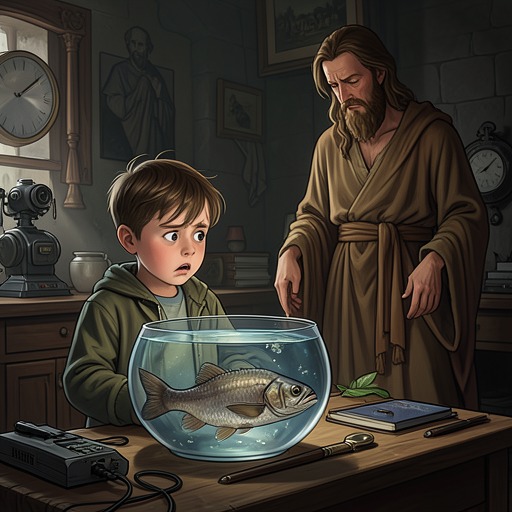
Much later, the image returns in a garden pool. For two weeks, at noon each day, the narrator feeds Koi (carp) rice cakes taken from the pantry. The fish lunge for the pieces, suck them down, and open their jaws so widely that the narrator can see toward their stomachs. Instead of becoming accustomed to the sight, the narrator grows more depressed. The feeding scene makes the Tube visible from outside: the fish expose the digestive passage that ordinary creatures keep concealed.
The narrator interprets this exposure as a breach of a primordial taboo, then recognizes that the same digestive structure belongs to people, including Mother and the narrator’s sister. The fish are repugnant not because they are wholly unlike human beings, but because their visible mouths make a concealed likeness difficult to ignore. The narrator’s own earlier sense of being different, of possessing greater thoughts, is challenged by the accusation that a person is still a tube emerging from a tube. The image thus returns not as neutral physiology but as a threat to an elevated self-conception.
The pool changes in meaning along with the narrator’s perception. Its bright surface had seemed to belong to a protected, perfect garden; now the garden harbors death. Faced with the carp’s hungry mouths and the alternative of slow vegetal putrefaction, the narrator considers whether feeding them is a divine message and allows the disturbing voice to speak. Its formulation—“Life is a tube that swallows and remains empty”—joins the infant’s original bodily pattern to the adult narrator’s crisis. Tube-Like Existence consequently holds together two opposed recognitions: that human beings remain bound to the body’s repetitive demands, and that seeing this condition can make continued life feel newly difficult to choose.